Italy Struggles at the Olimpico: Belgium Wins 2-0, the Stands Empty Out
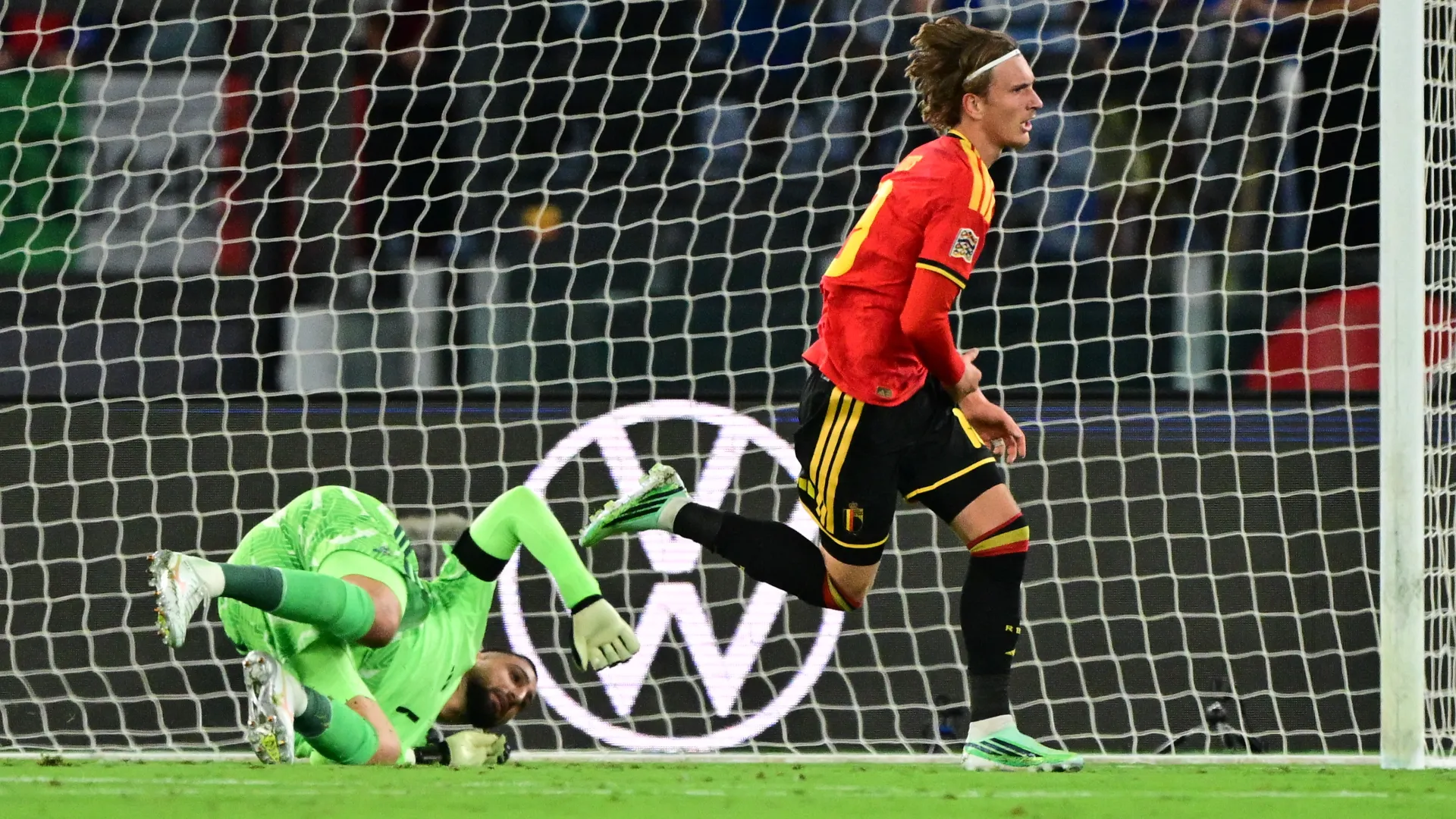
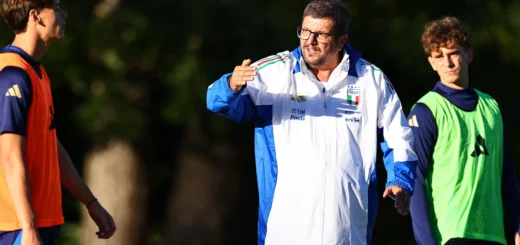
Roberto Mancini’s first match in charge of the national team ends just as it began—with boos from the Stadio Olimpico. Italy-Belgium ended 0-2, a stumbling start to the Nations League that also raises serious concerns about the Azzurri’s overall balance, as they were punished in the 21st and 69th minutes by Mika Godts and Dodi Lukebakio following two turnovers. More broadly, the numerous errors and the sense of general disarray displayed by the team were alarming—so much so that they even prompted part of the Rome crowd to leave the stands a quarter of an hour before the final whistle.
The same scenario played out identically in both halves: first Alessandro Romano, then Nicolò Barella lost the ball in midfield, gifting Belgium the two decisive counterattacks. The visitors’ opening goal in the 21st minute came precisely from a ball snatched from the Cagliari midfielder’s feet by Kevin De Bruyne, followed by a through ball to Godts. Lukebakio’s second goal in the 69th minute, on the other hand, capitalized on a lapse by Barella in the opponent’s attacking third and his teammates’ failure to track back, sparking great anger from Mancini on the bench. In between, the Azzurri had squandered three clear chances to equalize through Kean, Gianluca Mancini, and Pio Esposito, before the head coach made a triple substitution, bringing on Scalvini, Frattesi, and Maldini.
Among the evening’s standout underperformers was Romano, whom the head coach had confidently bet on as the linchpin of the midfield. “I didn’t know much about Romano, but after the first matchday he made a good impression, so we wanted to see him,” Mancini had said on the eve of the match. “It wasn’t easy, but we believe he can be very valuable for the future of the national team. He reads the game well, plays one-touch soccer, and will therefore be important going forward. Claudio Ranieri, who coached him at Roma, also played a key role.” A bitter debut, then, for the midfielder born in Winterthur on June 17, 2006, to a family with roots in Naples and Puglia, who had come up through the Swiss youth ranks before being scouted by Roma in 2022 and then joining Cagliari after a loan stint at Spezia in Serie B. FIFA had approved the change of sporting nationality, paving the way for his call-up to the Azzurri—a decision that did not go unnoticed in Switzerland: “If someone has come up through the ranks here and then prefers to play for Italy, let him play for Italy. The Swiss national team doesn’t have to beg anyone,” former Swiss international Alberto Regazzoni had commented with a touch of bitterness.
The evening had, in fact, gotten off to the worst possible start even before kickoff, marking yet another dark chapter for Italian soccer. As the national anthems were played, part of the crowd in the stands booed “La Brabançonne,” the Belgian anthem. The rest of the fans tried to drown out the boos with applause, but the damage was already done—and on an international scale. This incident comes at an already delicate time for Italian soccer, fresh off its third consecutive failure to qualify for the World Cup, and just days after the uproar caused by some Juventus ultras’ failure to observe a moment of silence for Sandro Mazzola, which cost the club a 10,000-euro fine from the Sports Judge.
The result weighs even heavier in light of the context in which it occurred. Mancini had returned to the Azzurri bench with the stated goal of winning back an angry fan base: “Regarding the decision I made years ago, I’ll have to do well to win back the Azzurri fans who got angry or felt betrayed,” the head coach himself admitted at a press conference in recent days. That goal became immediately more difficult to achieve following the match at the Olimpico. Now the schedule leaves no room for maneuver: following this defeat, Italy will face Turkey twice before wrapping up the first block of matches with a challenging away game in Saint-Denis against Zinedine Zidane’s France. In League A Group 1, the minimum goal remains securing one of the top two spots to advance to the quarterfinals scheduled for March 2027, but the road has already become an uphill battle after just ninety minutes.