September 7, 1975: 50 years ago at Monza, Niki Lauda’s first world title with Ferrari
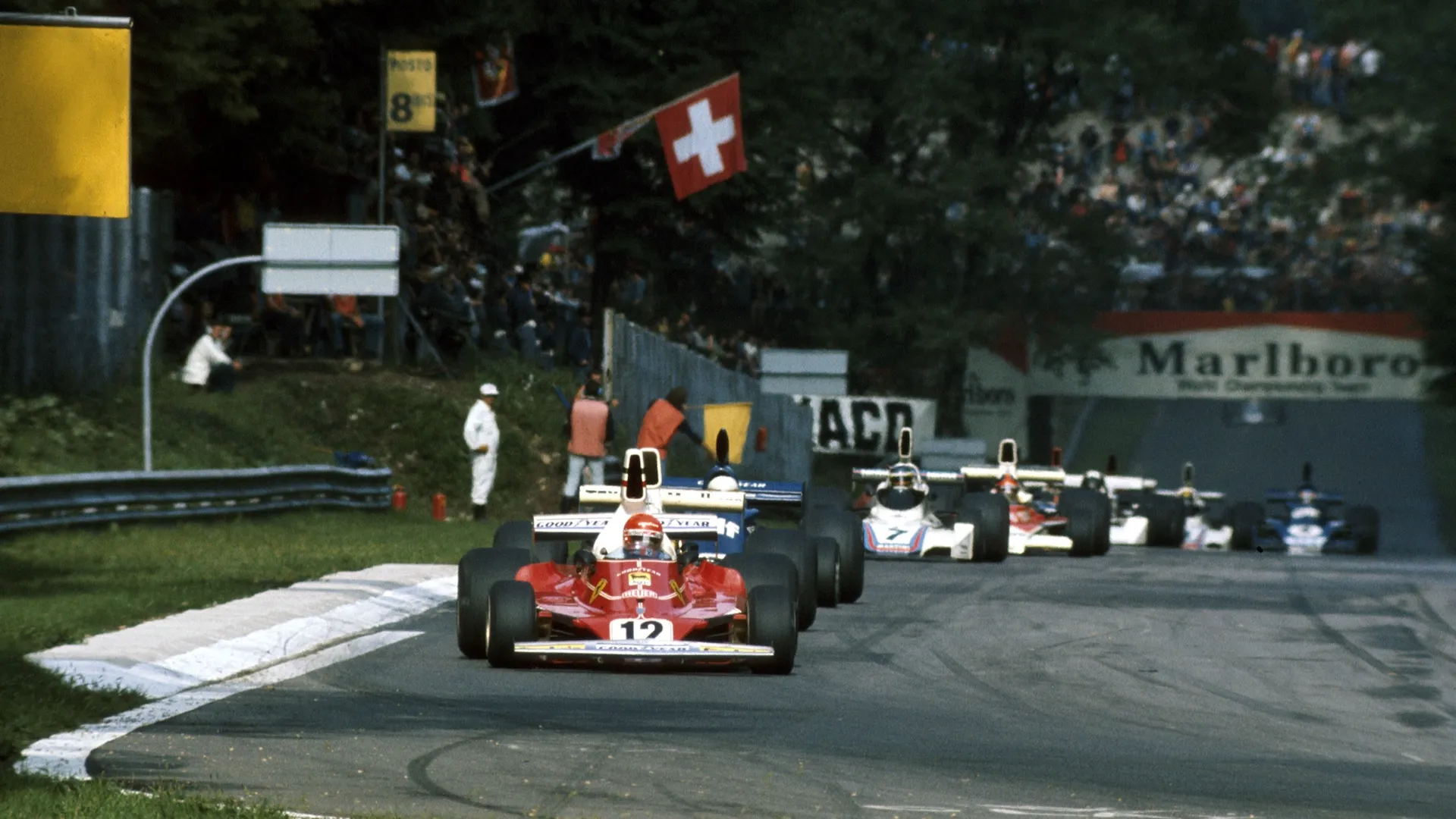
It is Sunday, September 7, 1975, and the Italian Grand Prix is being held at the Monza circuit, which can bring back a Ferrari driver right in front of his fans to win the Formula 1 world title after eleven years. That driver was Niki Lauda, 26, who had arrived the previous year at the court of the Drake and sporting director Luca di Montezemolo, who had very quickly become his great friend and protector to the detriment of Clay Regazzoni, who had accompanied Lauda with him to Maranello from BRM and who had lost the 1974 title at the last race at the hands of McLaren’s Brazilian Emerson Fittipaldi.
At that race, the penultimate race of the season, Lauda, who had won four Grands Prix in that 1975 race, arrived 17.5 points ahead of Carlos Reutemann, the Argentine driver of Brabham who is the only one who can still snatch the title from him. Why 17.5 points and not 17 or 18? Because Lauda on Aug. 17 at his home circuit, the Österreichring, finished sixth, but instead of taking a point in the standings he took only half a point because the Austrian race was stopped well in advance because of heavy rain. If Niki in Monza finished in the points zone, which then included the top six positions, the title would automatically be his, so even the tiny point of sixth place would be enough for him to succeed Maranello’s last rainbow driver, John Surtees, triumphant in 1964.
The two days of practice (at that time there was no distinction between free practice and qualifying: the best time of each driver, whether it was done on Friday or Saturday, was valid for the starting grid of the Sunday race) saw the domination of the Ferrari drivers, who monopolized the front row with their marvelous 312 T cars designed by Engineer Mauro Forghieri: Lauda took his eighth pole position of the season, 51 hundredths ahead of Regazzoni. Third at 84 cents is Fittipaldi, who will be joined on the second row by South African Jody Scheckter’s Tyrrell. Reutemann, on the other hand, does not go beyond seventh place.
Sunday morning it pours, so much so that the warm-up is held on a wet track and there are even fears of having to postpone the race. But at noon the sun shines again, the track dries and, albeit about a quarter of an hour later than originally planned to allow the drivers to do a couple of additional reconnaissance runs on slick tires, the start can be given, and the Ferraris immediately take the lead. It is Regazzoni who takes the lead ahead of Lauda at the first corner, which is not the chicane located at the end of the pit straight but the Curva Grande, as the variant on the first pass is made for the drivers to jump to avoid dangerous pile-ups. The Ticino driver immediately takes a good lead over his teammate.
The pileup, however, happens at the beginning of the second lap, after a first lap in which, without today’s DRS, there has already been a great deal of overtaking: Scheckter, chasing Lauda, goes straight into the chicane and ends up in the run-off lane; McLaren’s German Jochen Mass, following close behind, is misled and hits the guard-rail turning around, obstructing the track and causing collisions between Mario Andretti and Tony Brise and between Hans-Joachim Stuck and Harald Ertl. There was also great anticipation for local idol Vittorio Brambilla, the “gorilla of Monza,” who had won resoundingly three weeks earlier in Austria with the March thanks to the wet track, of which he is a great specialist, but who was ninth on the grid and on top of that at the start was stopped due to having burned out the clutch, managed to start very late but shortly after the end of the first lap retired.
Because of engine problems in his Lotus, Swedish driver Ronnie Peterson, the winner of the last two Italian Grands Prix, also drops out at the end of the first lap. At the end of the second lap Regazzoni leads ahead of Lauda, Reutemann, Fittipaldi, James Hunt, who in the Hesketh that year won at Zandvoort beating Lauda, and Frenchman Patrick Dépailler in the Tyrrell. Despite the incident at the beginning of the second lap there is of course no red flag, let alone any safety car, which appeared sporadically for the first time in the 1973 Canadian Grand Prix at Mosport, creating such confusion even for the timekeepers that it had not been shown again and would not be again until 1993.
It looked like the race might end in a Ferrari one-two, as the two Prancing Horse drivers took a short time to take the lead over everyone else, with Lauda playing wingman for once, looking over his shoulder for the most dangerous rivals and protecting Regazzoni’s, but Fittipaldi, who had already had to mathematically concede the title, wanted to prove that he was still the best: on the 14th of the planned 52 laps he overtook Reutemann, launched himself in pursuit of the Ferraris and overtook Lauda with seven laps to go at the pit-straight chicane, which from the following year would be replaced by the double Variante Goodyear, replaced in turn in 2000 by the present variant, while after the Curva Grande and before the two Lesmo curves the following year the Variante della Roggia would also pop up. Instead, there has already been since 1972, more or less as it is now, the Ascari Variante, at the old Curva del Vialone.
Regazzoni, who by lap 30 had clearly pulled away from Lauda, has too much of an advantage for Fittipaldi to trouble him and goes on to win his third Formula 1 rainbow race, the second at Monza after the 1970 race, and Emerson is second for the third consecutive year at the Brianza circuit. But the real celebration is for Lauda, who despite a serious problem with the right rear shock absorber (here is why he had to let Regazzoni go) manages to finish third and win his first world title with one race to spare. Ferrari also took home what was then called the Constructors’ Cup, which had much less importance than the constructors’ world championship of today.
Reutemann was fourth but very close behind, fifth Hunt and sixth the promising Welshman Tom Pryce in the Shadow. The fans are in a frenzy over the triumph of Lauda, who despite his shady character and less-than-spectacular way of racing has made the fans love him to the tune of victories. Beautiful were the days when the Italian Grand Prix was one of the very last stages of the world championship and the world titles could be awarded there. And beautiful above all were the days, like the one exactly 50 years ago, when it was Ferrari fans who could celebrate…