2026 World Cup: Nearly a Century of History—All the Finals Leading Up to Spain vs. Argentina
The final of the 23rd edition of the World Cup will pit Spain against Argentina on a sweltering afternoon at MetLife Stadium in East Rutherford on Sunday, July 19. The two national teams, which have a combined total of four titles (one for Spain, three for Argentina), have never faced each other on such a stage: in this regard, it’s worth looking back at the history of the World Cup final, which has delivered major surprises on more than one occasion.
The history of the World Cup began in 1930 in Uruguay, and it was La Celeste that claimed the first world title (the third, according to the South American country’s tradition, which also counts the 1924 and 1928 Olympic Games as world titles). At the Estadio Centenario in Montevideo, it was Argentina that was defeated by a score of 4–2: Uruguay took the lead in the 12th minute with a goal by Pablo Dorado; the Albiceleste fought back with goals by Carlos Peucelle in the 20th minute and Guillermo Stabile in the 37th minute; Uruguay then staged a comeback with goals by Pedro Cea in the 57th minute, Santos Iriarte in the 58th minute, and Héctor Castro in the 89th minute.
In 1934, however, it was Italy—making its debut—that won the tournament, which was held on home soil. The national team, led by Vittorio Pozzo, defeated Czechoslovakia 2-1 in Rome after extra time: Antonin Puc put the Azzurri’s opponents ahead in the 71st minute, Raimundo Orsi equalized in the 81st minute, and in the 5th minute of extra time, Angelo Schiavio sealed the victory. The Azzurri’s second title came in France in 1938: a 4-2 win over Hungary with two goals each from Gino Colaussi (6’ and 35’) and Silvio Piola (16’ and 82’); the Hungarians scored through Pal Tiktos in the 8th minute and Gyorgy Sarosi in the 70th minute.
After the forced hiatus due to the war, the World Cup returned in 1950 in Brazil and featured a format—never repeated since—with a final round consisting of four teams. Coincidentally, the final match—between the host Seleção and Uruguay—was also the decisive one: Friaça put the Brazilians ahead in the 47th minute, Pepe Schiaffino and Alcides Ghiggia, in the 66th and 79th minutes respectively, turned the deficit around and left the more than 170,000 spectators at the Maracanã in despair. In hindsight, it is no coincidence that the event is remembered as the “Maracanazo” (or “Maracanaço,” in Portuguese).
Another epic final was that of the 1954 World Cup in Switzerland, known as “The Miracle of Bern”: the heavy favorites, the Hungarian Golden Generation, took a 2-0 lead after 8 minutes with goals by Ferenc Puskás in the 6th minute and Zoltán Czibor two minutes later, West Germany pulled one back with a goal by Maximilian Morlock in the 10th minute, equalized with a goal by Helmuth Rahn in the 18th minute, and completed the comeback with another goal by Rahn six minutes before the potential start of extra time.
In 1958, Brazil won its first title: at Rasunda Stadium in Solna, Sweden, the home team took the lead in the 4th minute with a goal by Nils Liedholm, only to be overwhelmed by a brace from Vavà in the 32nd minute and goals from a very young Pelé in the 58th minute and Mario Zagallo in the 68th minute. Agne Simonsson pulled one back in the 80th minute, but Pelé scored again with a header in the 90th minute—one of the most iconic goals in World Cup history—sealing the 5–2 victory.
Brazil’s “Golden Generation” also won the title in 1962 in Chile: their opponent in the final was Czechoslovakia, which they defeated 3-1 despite Josef Masopust’s opening goal in the 15th minute. Amarildo in the 17th minute, Zito in the 69th minute, and Vavà in the 78th minute secured the victory for the Seleção, the second and last national team (at least until Sunday night) to win two consecutive World Cups.
Four years later, one of the most controversial finals took place at Wembley, between England and West Germany: after a 2–2 draw in regulation (goals by Geoff Hurst in the 18th minute and Martin Peters in the 78th minute for England, and by Helmut Haller in the 12th minute and Wolfgang Weber in the 89th minute for West Germany), the English regained the lead again through Hurst in the 101st minute, even though the ball had not fully crossed the goal line. Swiss referee Dienst’s decision sparked outrage among the Germans, but he stood firm: Hurst struck again in the 120th minute, sealing the victory at 4–2.
Italy was a key player in the 1970 final: the national team led by Fulvio Valcareggi, however, went into the match against Brazil utterly exhausted after winning the semifinal against West Germany 4-3 in extra time, and despite a first half that ended 1-1 (Pelé’s goal in the 18th minute was answered by Roberto Boninsegna in the 37th), they collapsed in the second half under the onslaught of Gerson, who scored in the 66th minute, Jairzinho, who scored in the 71st minute, and Carlos Alberto, who beat Albertosi in the 86th minute for the final 4-1 score that definitively handed the Rimet Cup to the Seleção, securing their third-ever title.
In 1974, the Dutch “Totaalvoetbal” style dreamed of crowning an epic era, giving Germany a scare in the World Cup final (the first to be officially designated as such after the Rimet Cup was permanently awarded) in Munich: The Germans hadn’t even touched the ball yet when Neeskens scored a penalty kick to make it 1-0 in the 2nd minute, but they managed to turn the score around with another penalty kick, converted by Paul Breitner in the 25th minute, and with Gerd Müller’s decisive goal in the 43rd minute.
In 1978, the controversial World Cup in Argentina was won by the host nation, 3–1, once again over the Netherlands, which was without Johan Cruijff, who had chosen to stay home for personal reasons. Mario Kempes put Argentina ahead in the 38th minute; Dick Nanninga equalized in the 82nd minute, seemingly stunning the home team—so much so that Resembrink came very close to scoring in the final minutes, hitting the post. In extra time, however, goals by Kempes in the 105th minute and Daniel Bertoni in the 115th minute secured the first of the national team’s (so far) three World Cup titles.
In 1982, Italy won its third World Cup, defeating West Germany 3-1 in the final at Madrid’s “Bernabéu”: Cabrini’s missed penalty in the first half proved inconsequential, as the Azzurri scored in the second half through Paolo Rossi in the 57th minute, Marco Tardelli in the 69th minute, and “Spillo” Altobelli in the 81st minute. Breitner pulled one back in the 83rd minute, but, to paraphrase then-President of the Republic Sandro Pertini, who was cheering enthusiastically from the stands, the Germans couldn’t get another one in.
Four years later, the same German team suffered another disappointment, losing 3–2 to Diego Armando Maradona’s Argentina: Maradona himself did not score in the final, but his teammates José Luis Brown in the 23rd minute, Jorge Valdano in the 56th minute, and Jorge Burruchaga in the 84th minute. The German goals by Kalle Rummenigge in the 74th minute and Rudi Völler in the 81st minute were merely for the record books. The two teams also faced off in the final at Italy ’90: the match at the Olimpico, remembered for its lack of excitement, was decided by a (controversial) penalty kick converted by Andy Brehme in the 85th minute.
At USA ’94, Italy returned to the final twelve years after its last appearance, but the outcome was quite different: Facing Romario and Bebeto’s Brazil under the scorching sun of Pasadena—with a battered Roberto Baggio and a Franco Baresi who had just returned from meniscus surgery on the field—the Italian national team finished regulation and extra time at 0-0. In the first final in history decided by a penalty shootout, they paid the price for the mistakes made by the Milan captain, Daniele Massaro, and “Divin Codino,” whose look of disbelief is still remembered by many today.
Four years later, Brazil had the chance for another historic repeat, against host nation France. Before the match, however, the phenomenon Ronaldo experienced health issues that led Coach Zagallo to remove him from the starting lineup, only bringing him back at the very last minute. The great Brazilian striker was a shadow of his former self on the field, and Les Bleus had an easy time of it, winning 3-0 with a two-goal performance by Zinedine Zidane—scoring in the 27th and 46th minutes of the first half—and a final goal by Emmanuel Petit in the 93rd minute.
Ronaldo got his big revenge in 2002, in the final in Yokohama: the 2-0 victory over Germany made Brazil five-time champions, and R9 scored both goals—in the 67th and 79th minutes—taking advantage of the opposing goalkeeper Oliver Kahn’s mistakes. That victory at the Japan-Korea World Cup remains Brazil’s last; since then, they haven’t even managed to reach the final.
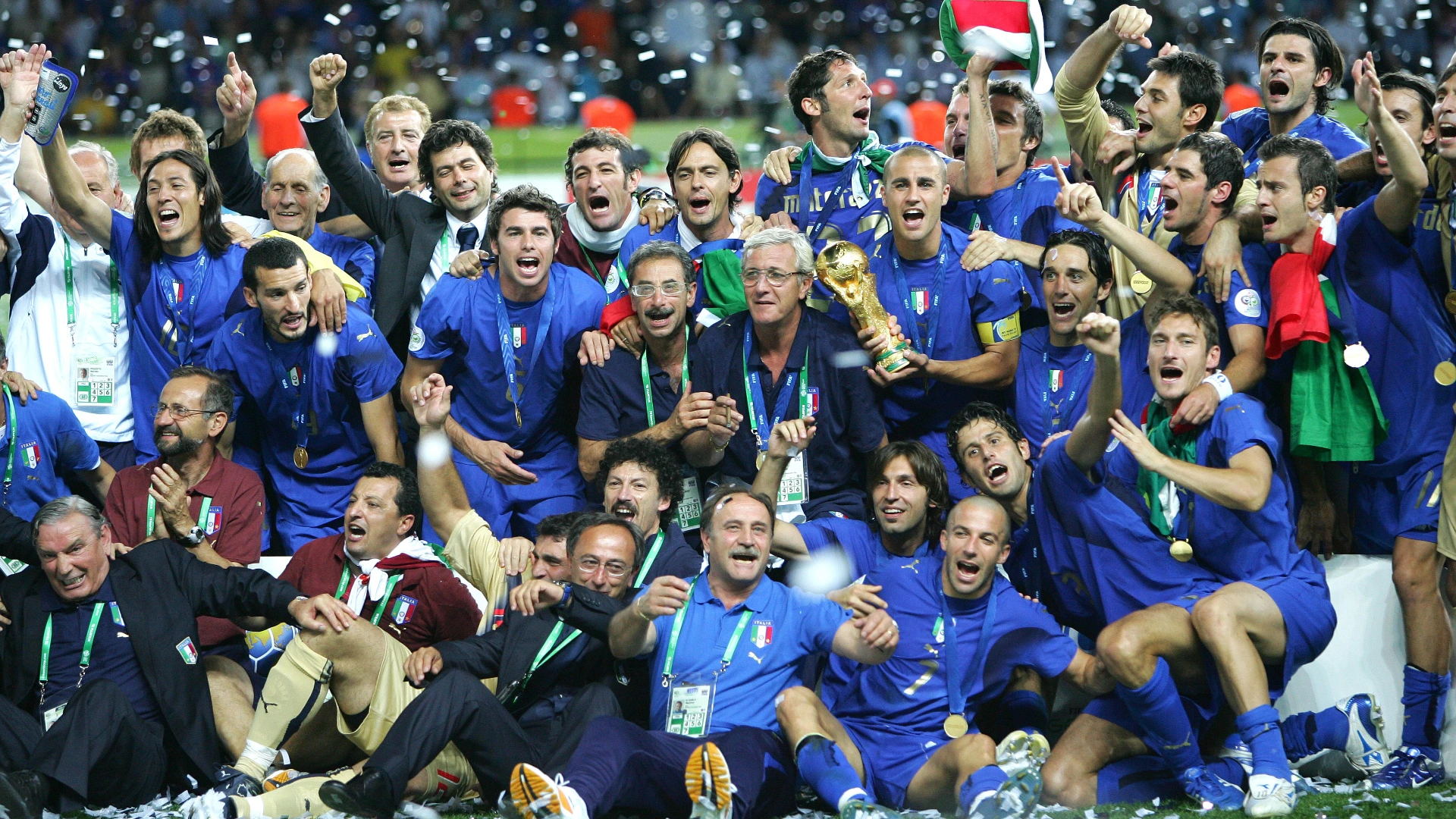
At the 2006 World Cup in Germany, Italy returned to the top of the world: in the final against France, the Italian national team fell behind after Zidane scored on a penalty kick in the 7th minute, but equalized with Marco Materazzi’s winning header in the 19th minute. The same two players were at the center of the key incident in extra time, with Zizou sent off for headbutting the Italian player in the 110th minute. The penalty shootout ended 5–3 in Italy’s favor: David Trezeguet was the only one to miss (the ball hit the crossbar), while Fabio Grosso scored the decisive penalty.
In 2010 in South Africa, Spain claimed its first (and, at least until tonight, only) title: facing the Netherlands, La Roja prevailed in extra time with a winning goal by Andrés Iniesta in the 116th minute. The Oranje remain the national team with the most World Cup final losses—three in total—among those that have never won the title.
In 2014, in Brazil, Germany—which had defeated the Seleção 7–1 in a sensational semifinal—faced a far from easy match against Argentina, but still managed to prevail 1–0 in extra time, thanks to Mario Götze’s game-winning strike in the 113th minute. In that match, Lionel Messi was one of the most heavily criticized players; he would have the chance to prove everyone wrong a few years later.
In 2018, in Russia, France won the World Cup again, twenty years after its first victory: in the final, Les Bleus defeated underdog Croatia 4–2, making the most of Mario Mandzukic’s own goal in the 18th minute, Antoine Griezmann’s penalty kick in the 38th minute, and the one-two combination by Paul Pogba and Kylian Mbappé between the 59th and 65th minutes. Mandzukic made up for his first-half mistake by scoring Croatia’s second goal, but it was the team led by Didier Deschamps that lifted the trophy.
Les Bleus then had the chance to repeat their success in 2022 in Qatar: the final against Argentina was a rollercoaster of emotions, with France staging a comeback—thanks to a brace by Mbappé, first from a penalty kick in the 80th minute and then from open play just seconds later—to counter goals by Messi in the 23rd minute from the penalty spot and Angel Di María in the 36th minute. In extra time, Messi scored again to make it 3-2 in the 108th minute, but Mbappé, once again from the penalty spot, tied the score at 3-3 in the 118th minute. In the penalty shootout, however, misses by Kingsley Coman and Aurelien Tchouameni proved decisive, and Gonzalo Montiel sparked wild celebrations for the Albiceleste.