Seven Ideas 2026: The Festival de L’Espresso Closes with Impressive Numbers
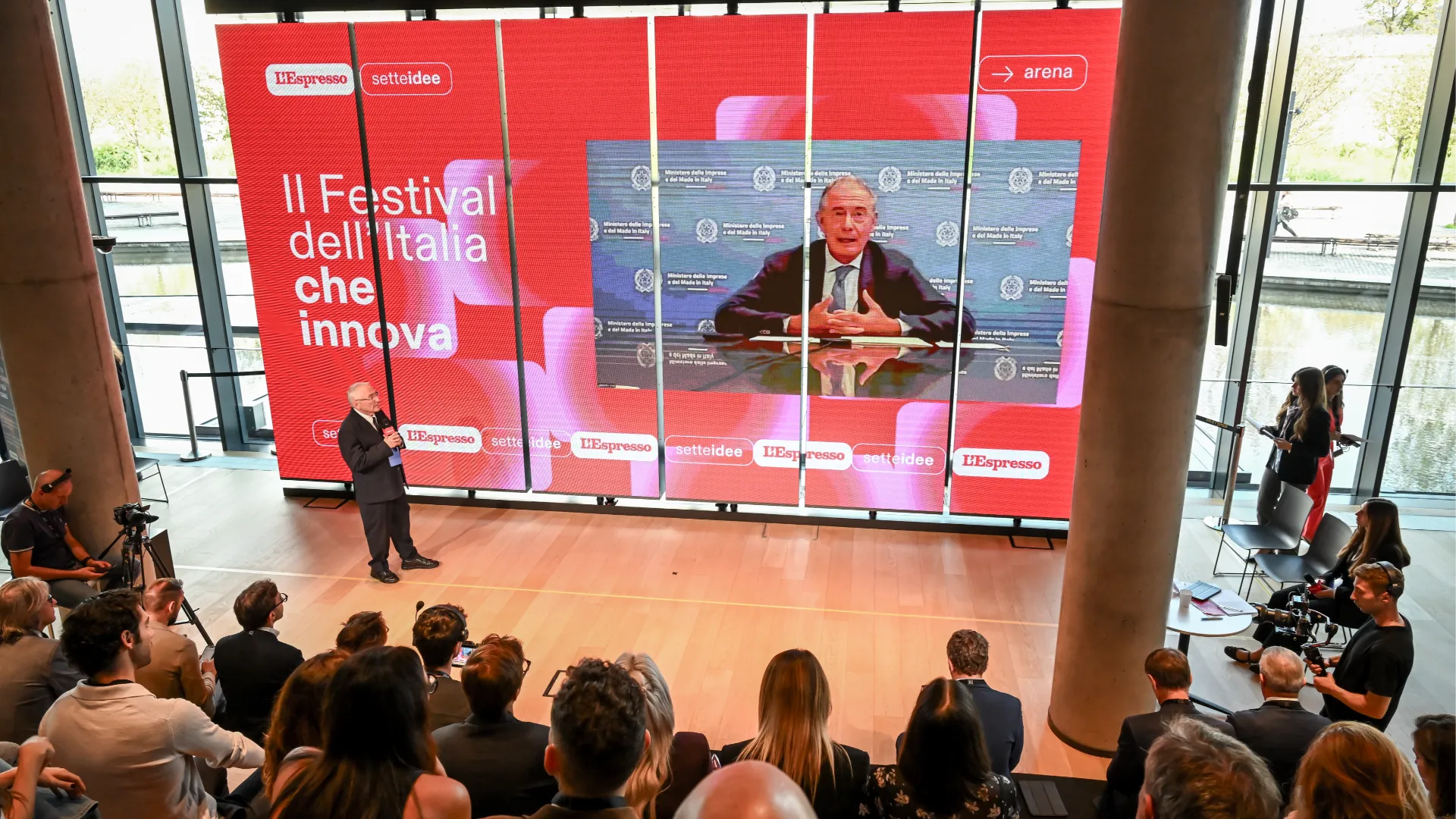
Over 22 hours of live coverage, thousands of people—including those who packed the arena at the STEP FuturAbility District and those who tuned in via social media and the L’Espresso website— 98 startups competing out of 374 applicants, over 40 judges, and about 50 institutional speakers: these are the figures marking the conclusion today in Milan of the second edition of “Sette idee,” the Festival of Innovative Italy, organized by L’Espresso. On September 17 and 18, from 10 a.m. to 9 p.m., the startups competed in a series of pitch competitions before the top executives of major Italian companies, in a fast-paced alternation with political discussions.
Numerous leading figures in Italian and European politics enthusiastically accepted L’Espresso’s invitation, sparking a lively debate one year ahead of the elections. The political and institutional program featured the participation of Ministers Adolfo Urso, Tommaso Foti, Paolo Zangrillo, and Maria Elisabetta Alberti Casellati; Deputy Ministers Francesco Paolo Sisto and Edoardo Rixi; Undersecretaries Paola Frassinetti, Isabella Rauti, Alberto Barachini, Luigi Sbarra, and Marcello Gemmato, as well as Chamber of Deputies Vice President Anna Ascani. Representing the regions were Regional Presidents Alessandra Todde, Eugenio Giani, and Roberto Occhiuto, and Lombardy Regional Councilor Claudia Maria Terzi; for Milan, Mayor Giuseppe Sala, Deputy Mayor Anna Scavuzzo, and Councilor Alessia Cappello. From Brussels, MEPs Brando Benifei, Pasquale Tridico, and Nicola Zingaretti. Also on the agenda were a discussion between Nicola Fratoianni and Maurizio Lupi; remarks by Carlo Calenda, Benedetto Della Vedova, Francesco Boccia, and Stefano Candiani; and a segment dedicated to the new faces of politics: Bernard Dika, Simone Leoni, Paolo Romano, Jacopo Gasparetti, and Matteo Hallissey. Also in attendance were two former prime ministers, Massimo D’Alema and Matteo Renzi, who closed the Festival.
The 98 startups competed across 7 categories: Education, training, and welfare; Tourism, Food & Wine, and Hospitality; Medicine and Health; Mobility, Energy, and Infrastructure; Artificial Intelligence, Industry, and Space; Finance and Insurance; and Independent Publishing. However, the journey of the 14 finalists—two per category—does not end in the Milan arena: over the next two months, the startups will be guided through a mentorship program by Startup Geeks, a growth partner of Sette Idee, which will support them until the event in Rome. It will be at the Campidoglio itself that the seven winners will be announced: each startup will receive 40,000 euros in advertising credit to be invested in 2027 across L’Espresso’s channels, including the magazine and digital platforms.
The lights go out on the arena, but for Sette idee, this is merely a passing of the torch: while the finalists continue their journey toward Rome, L’Espresso is already looking ahead to the next edition, scheduled to take place in Milan in June 2027, with applications opening in October. Three new categories will be added to the existing seven: Sea, Ports, and the Blue Economy; Home, Living, and Regeneration; and Sports, Movement, and Facilities—the first category designed for the year in which Italy comes to terms with the legacy of the Milan-Cortina Winter Olympics.
The Festival also served as an opportunity to announce L’Espresso Academy, the group’s new training initiative, which was unveiled during a discussion with MEP Nicola Zingaretti. The Academy will debut in 2027 with the goal of bridging two gaps: the gap between what is learned in universities or journalism master’s programs and the actual work of a newsroom, and the gap in managerial skills within the Italian publishing industry. The chosen model is role-playing: short programs, ranging from three weeks to one month, built around a real-world experience at an institutional venue. This formula has already been tested with European Byline, which in 2026 brought over 20 students from across Italy to the European Parliament in Brussels for press conferences and interviews with MEPs. Funding will be hybrid, combining direct investment from the group with scholarships supported by public and private partners.
“Sette idee” was sponsored by the Ministry of the Environment and Energy Security (MASE) and the Ministry of Enterprise and Made in Italy (MIMIT), as well as by the City of Milan and Roma Capitale. “Startups can be one of the most important drivers of Italy’s energy and environmental transition,” stated Gilberto Pichetto Fratin, Minister of the Environment and Energy Security. The main partner for the 2026 edition was Q8 Italia.
Other partners included: Alpitour World, ASI (Italian Space Agency), AWS (Amazon Web Services), Bauli, Canon, Cassa Depositi e Prestiti Venture Capital, CETIF, Concentrix, CONOU, Cosmico, Elica, Famiglia Cotarella, Fastweb, FIPE, FIVERS, Frab’s Magazines / Mag to Mag, Pellegrini Group, San Donato Group, Havas, IED, Intrecci Alta Formazione, ISAB, LeverPR, Link Campus University, LinkedIn, Ludoil, Renco, SheTech, Startup Geeks, Startup Italia, Style Lab, Talent Garden, TheFork, Uber, UCB Pharma, UniCredit, United Network, Parthenope University, University Network, ViviBanca, VisitItaly.