Valentino Rossi, a heart-wrenching tribute to Marco Simoncelli: “It weighs on my heart”
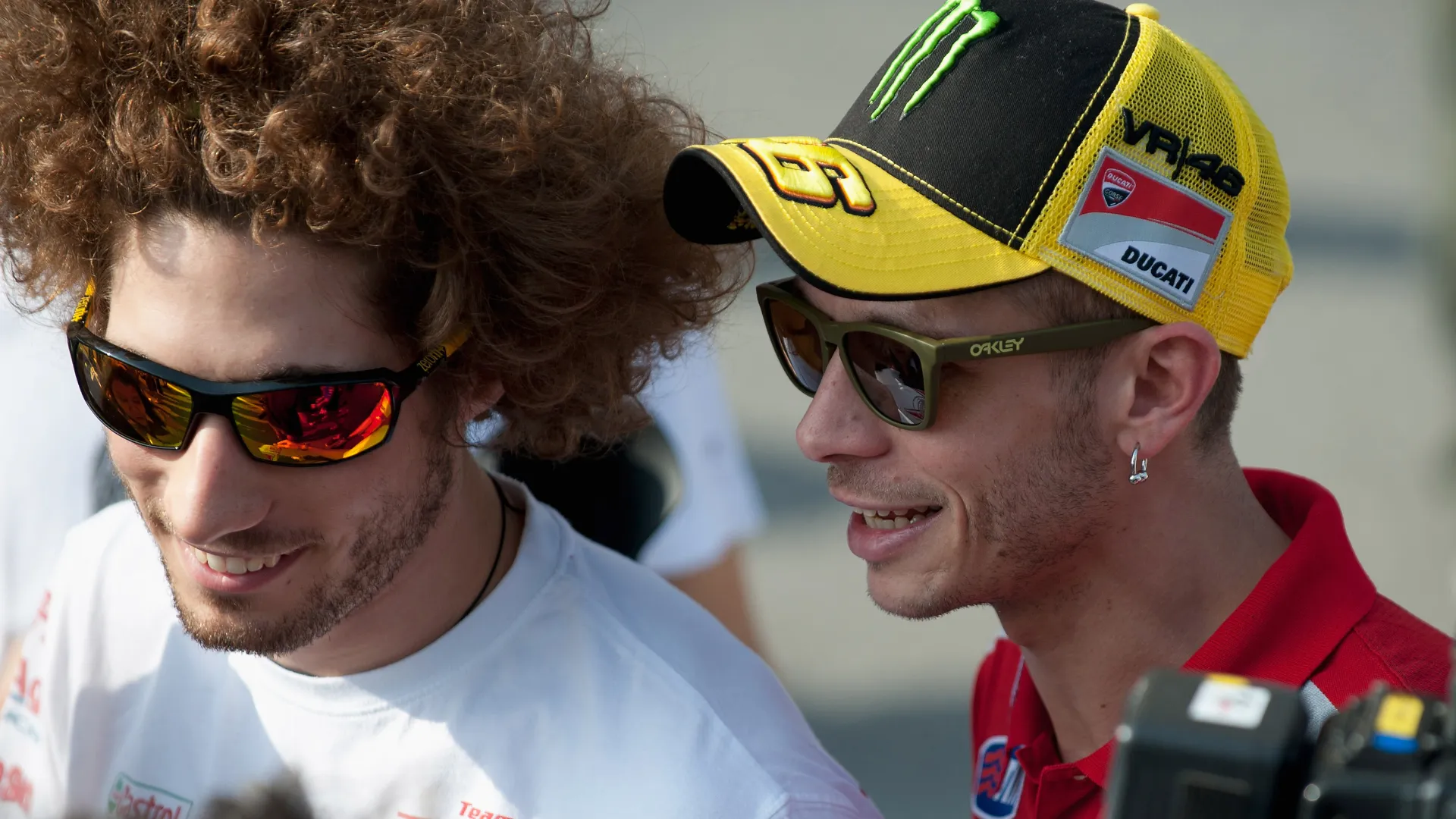
Valentino Rossi revisits one of the most dramatic moments of his life in his autobiography “Valentino Rossi, My Story,” co-written with journalist Giorgio Terruzzi and set to be released on Tuesday, November 10, by Rizzoli. In an excerpt published in advance by *Corriere della Sera*, the nine-time world champion recounts the tragedy at Sepang on October 23, 2011, when Marco Simoncelli lost his life after being struck during the Malaysian Grand Prix.
It is an intimate and particularly painful account, in which Rossi recounts his relationship with his friend, the moments leading up to the accident, and above all, what happened immediately afterward. This memory is accompanied by a feeling that has tormented him for a long time: the conviction that he was, at least in part, involved in that tragedy.
The bond between Rossi and Simoncelli began when the rider from Romagna was still very young. Valentino remembers him fondly, also noting his physical appearance and his exuberant personality: “I met him when he was a young boy. No, actually, a big kid. He was born in 1987. He must have been fifteen, maybe sixteen. Tall—really tall—with two huge legs that reached all the way up here, a slightly short torso, very long arms, and big hands too, which he’d wave around while talking. He looked a bit like a cartoon character, like Goofy, Mickey Mouse’s friend. In fact, Goofy was also his nickname. A big guy just like us, raised surrounded by the countryside and the sea, in Romagna, down there, like a sight that stays in your eyes, in your mind. During the winter of 2006–2007, he came to me and said, “Vale, I need to get better, to lose weight. “Will you take me on to train with you?”
The Doctor then explains that he never considered Sic a rival, even though both were destined to become stars of the MotoGP World Championship: “I certainly wasn’t worried that Marco might become a rival; I saw him more as a younger brother to support. Without realizing it, I was treating Simoncelli like the guys who would go on to form the Academy later on. It came naturally with Sic because he was so likable, kind, and always fun. He had a heart this big, good-natured and down-to-earth, just like us. We were true friends, back when things were going well for both of us. We were both world champions at the same time in 2008—me in MotoGP, him in the 250cc class. He was set to make his MotoGP debut in 2010 on a Honda with the Gresini team.”
The most intense part of the excerpt naturally concerns the Malaysian Grand Prix on October 23, 2011. Rossi reconstructs with impressive precision the final moments before the crash, when Simoncelli lost control of his Honda and ended up in the path of the other riders: “Sunday. The lights go out, and we’re off. Second lap. Marco gets into a battle with Bautista, the Spanish Suzuki rider. Simoncelli moves in, Bautista crosses over; they reach the braking zone for Turn 9 still locked in a battle. Then, a right-hand turn—Turn 10—a long sweeping curve, before leaning into Turn 11. They dive in. The moment Sic opens the throttle—leaning as he is—his front end locks up. He falls. I see him veer outward, to the left. When that happens—when I see a rider in front of me slide to the ground—in a fraction of a second, I clear the file. Out. He’s no longer in the race. So, Simoncelli: delete. There’s no time for anything else—zero. I’m heading into the right-hand turn myself, ducking low behind the fairing, opening the throttle, and catching a glimpse of something coming back toward me from the center of the track. Not a shape, but an indistinct form—like a shadow I sense before I realize what’s happening. What’s happening is that Simoncelli is coming toward me, clinging to his bike. From the moment I saw him fall and disappear from my view, a second—maybe a second and a half—must have passed. During that time, Marco, using his strength, had tried to pull the bike upright, but the slide had slowed him down too much, and now he was lying on the ground, clinging to the Honda. That’s why he’s continuing to move forward, almost spinning on his own axis, to the right, toward the inside of the curve. It’s like spinning on a pivot. And he’s moving forward. He’s moving forward, damn it. I’m already accelerating when I realize that the shadow is coming toward me and turning into a presence. Colin Edwards is right on my tail, on the inside; we’re battling it out. In an instant—a tiny fraction of a second, right at the very last moment—I realize that the tangible presence is a motorcycle, it’s Sic’s bike, and he’s there, clinging to it, lying flat alongside it. We both hit him: Colin first, and I right after him. I go right over him; I feel the impact under my wheels. Edwards takes the hardest hit—it feels like I hit him second. The Ducati’s rim snaps, but I stay upright. I keep going by inertia, into the grass on the inside. I’m scared, confused; it seems like something serious happened, but not that serious, because I don’t feel like I hit Marco head-on. I head toward the pit. I pull in, come to a stop, and Uccio comes toward me. He’s distraught. He says, “His helmet flew off… His helmet flew off.” I curse, close my eyes, and rant, because the helmet is the helmet, and if the strap breaks, it means the crash was devastating. Footage of the accident starts playing on the monitors. I see the moment of impact. A total, profound sense of despair washes over me. I feel responsible for what happened. It’s a burden that even the fact that it was a random accident can barely contain. I think of Marco, of how he must be feeling right now. I remember the silence.”
Rossi also recounts the moment when Marco’s father, Paolo Simoncelli, announced his son’s death. It was devastating news that left the rider from Pesaro completely speechless: “He was right there; he’d seen everything and understood immediately. He’d climbed over the guardrail and made his way to Marco. He took his hand and realized it. He realized his son was dead. Uccio and I took the scooter and went to our room, crossing a paddock that looked like a ghost town. Not a soul in sight, just wind and silence everywhere. In the office, we sat down on the floor. We smoked a cigarette, then another, right away. We cried. I felt completely devastated; I didn’t know what to say or what to do—it was as if I’d been punched in the head. Dazed. We stayed in there, silent, for an hour, maybe longer. I think I’ve blocked out the rest; I don’t remember talking to anyone. But I do know what happened that night, the next day, and the days that followed. Because that’s when you start asking yourself a lot of questions, feeling guilty. What could I have done? I kept replaying the scene, the whole sequence of events. Could I have seen what was about to happen? Could I have been more careful? Moved further to the right, avoided the collision? The answer is no—said now, some time after the accident. But in those days immediately following Sic’s death, I didn’t have a single answer.”