Farewell, Varenne, the Captain who taught us to fly without wings
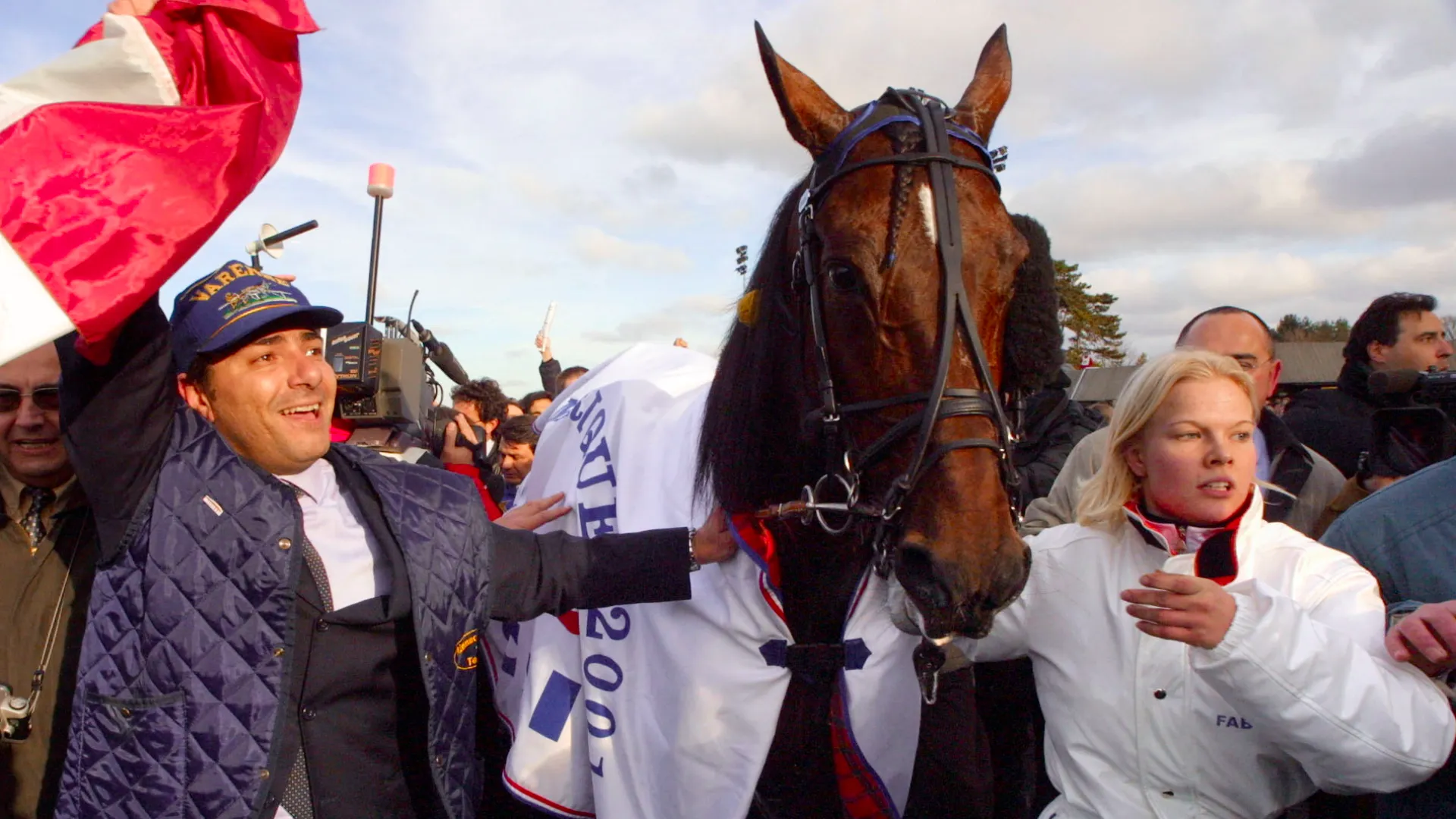
There are champions who stop competing and slowly fade into memory. Then there are others who never really stop. They remain there, in a corner of the collective memory, motionless yet always in the race. Just say his name, and the sound of the track, the announcer’s voice, the tension of a start, and a straightaway that seems to go on forever all come flooding back. Varenne was one of those. In fact, Varenne was that very thing.
The Captain died during the night between August 17 and 18, at the age of 31, at the LJ stud farm in Eboli, where he was spending his twilight years. According to a statement from his staff, he was taken by a sudden heart attack.
Thirty-one years is a long time for a horse. It should be enough to prepare for the inevitable. But with certain champions, it doesn’t work that way.
Because Varenne seemed immortal.
He seemed that way when he raced, and he continued to seem that way even now that he no longer raced. Just knowing he existed, somewhere, was enough. He had become one of those constants that are part of our lives without us even realizing it. We didn’t need to see him every day. It was enough to know that the Captain was there.
As of today, he is no longer with us.
And suddenly, those more than twenty years since his last race seem like very few.
Varenne was born on May 19, 1995, in Copparo, in the province of Ferrara. The son of the American stallion Waikiki Beach and the mare Ialmaz, he would go on to build a career that even today seems too good to be true: 73 races, 62 wins, and over 6 million euros in prize money.
But to stop at the numbers alone would almost be doing him a disservice.
Because Varenne wasn’t simply the horse that won.
He was the horse everyone knew.
And that’s a huge difference.
In a country where horse racing was gradually losing the prominence it had enjoyed in earlier eras, he achieved something no marketing department could have planned: he took harness racing beyond the racetracks.
For a few years, Agnano, Vincennes, and Solvalla became familiar names even to those who wouldn’t have known how to fill out a betting slip. People turned on the TV to watch a horse race.
That horse.
It didn’t matter if you knew the rules, the times per kilometer, or racing strategies. When Varenne took off, you understood everything without needing an explanation.
There was him, and then there were the others.
And then came the moment when the Captain decided the race had to end.
With Giampaolo Minnucci in the sulky and Jori Turja preparing him, Varenne transformed victory from an exceptional event into something that seemed ordinary. And this was perhaps his most impressive talent: he made simple what was by no means simple.
In Paris, he won the Prix d’Amérique twice, in 2001 and 2002. In Naples, he won three consecutive editions of the Lotteria di Agnano, from 2000 to 2002. In Stockholm, he won the Elitloppet twice. In 2001, he crossed the Atlantic and also won the Breeders’ Crown in the United States. That same year, he accomplished an extraordinary feat, dominating the major European classics and then going on to win in America as well.
Italy had found its horse.
And it had given him a title: Captain.
A perfect nickname, because Varenne had something that went beyond speed. He had presence. When he entered the track, he seemed to know exactly why all those people were there.
They were waiting for him.
And he, almost always, kept his promise.
Those who were children or teenagers during the years of his exploits still hold onto memories that today have the slightly faded hue of beautiful things. Sundays in front of the television, the races recounted by fathers and grandfathers, the newspapers the next day. Even those who knew nothing about horse racing learned that name.
Varenne.
That was enough.
Like Coppi, Tomba, Valentino Rossi, Pantani. Champions capable of transcending the boundaries of their sport and becoming part of the collective heritage. With one difference, of course: Varenne couldn’t tell his own story.
He couldn’t explain a victory.
He couldn’t give an interview.
He couldn’t tell us if he felt the pressure, if he recognized the crowd, if he knew he’d become famous.
He could only race.
And perhaps that is precisely why we attributed so many human qualities to him: courage, pride, intelligence, dignity, and the will to win.
Perhaps they were our own projections. Or perhaps not.
Anyone who has lived alongside horses knows that there are languages that don’t need words.
Then came the time to say goodbye to the racetracks.
In September 2002, Varenne ran the last race of his career. He began a second life as a stud, leaving an enormous legacy through thousands of descendants.
But to the public, he always remained the horse of the home stretch.
Champions, after all, have this privilege: in our memories, they never grow old.
We do.
We who watched Varenne have grown older. Some have lost their hair, some have had children, some have become grandparents. Televisions have changed; smartphones, social media, and a whole new way of living and covering sports have arrived.
He hasn’t.
In our minds, he remains racing toward the finish line.
And perhaps this is why the news of his death hurts so much.
It’s not just a 31-year-old horse that has died. A small piece of the time when we watched him run has slipped away. And when something that belongs so deeply to our memories disappears, we inevitably realize that a part of our own lives has also become a thing of the past.
Today, racetracks can list his records.
Almanacs can recall his 62 victories.
The images can take us back to Paris, Naples, Stockholm, and New York.
But no statistic will ever truly explain what Varenne meant to those who saw him race.
It was the anticipation.
It was that feeling that something great was about to happen.
It was the certainty that, even when it seemed difficult, the Captain would find a way.
It was the noise that grew as he approached the home stretch.
It was an entire country that, for a few minutes, discovered a passion for harness racing.
Today, that track has fallen silent.
Varenne was 31 years old. He had lived a long life, enjoyed an unparalleled career, and spent his later years far from the pressure of competition. He passed away after having become everything a racehorse could be—and something no list of achievements could have foreseen: a piece of Italian popular history.
We like to think that great champions never truly reach a final finish line.
That somewhere, there’s always another home stretch.
That there are no more stopwatches, opponents, starts, or finishes.
Just space.
That’s why it doesn’t feel natural today to simply say goodbye.
It feels natural to imagine him just as he was back then.
Head held high. The sulky behind him. His stride quickening. The others trying to keep up.
And that unmistakable feeling that in a few seconds it would happen all over again.
Go, Captain.
Don’t look back this time.
Run.