When Switzerland didn't scare Italy
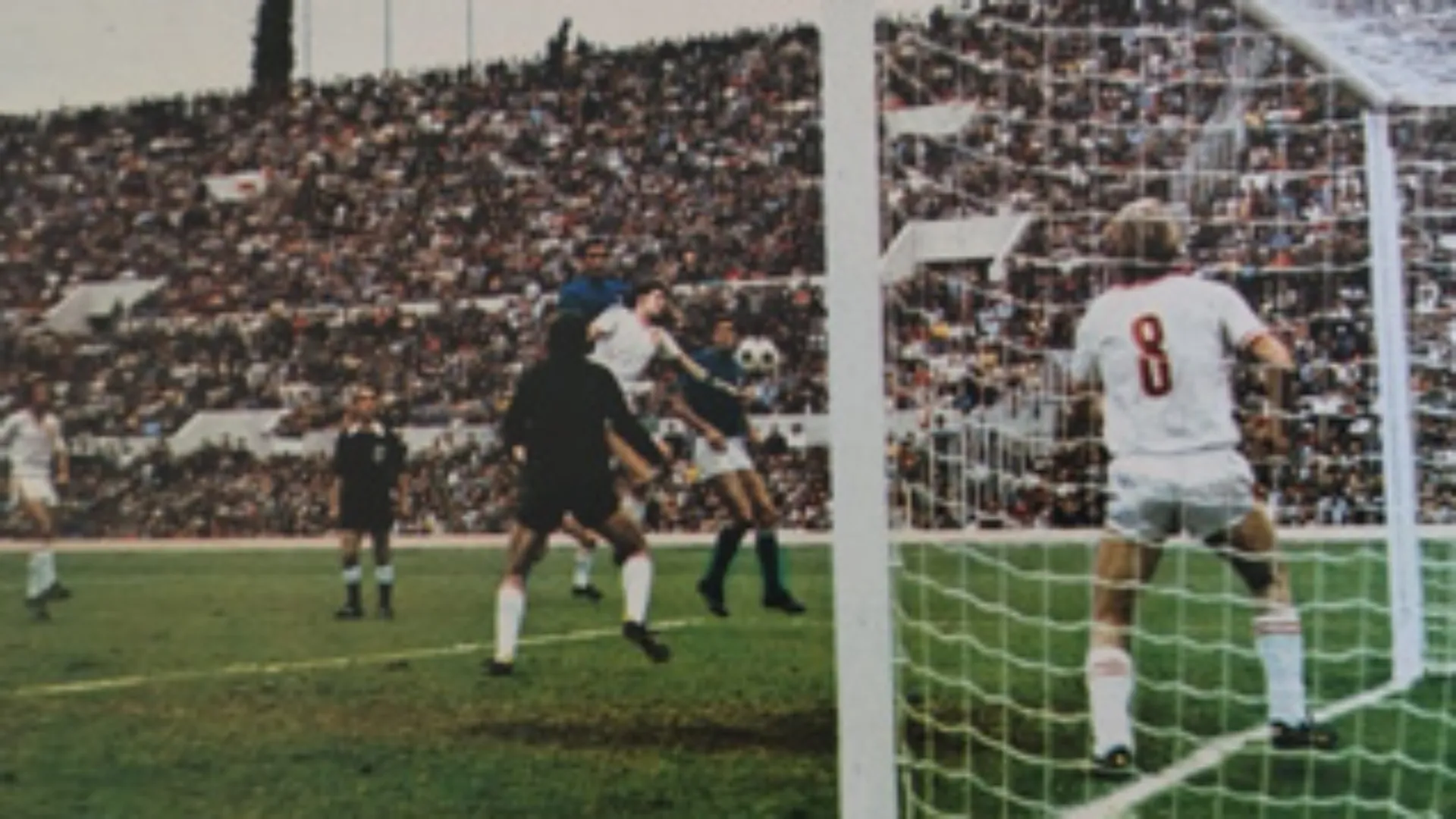
On Oct. 20, 1973, at the Stadio Olimpico in Rome, Italy and Switzerland are competing for qualification for the 1974 World Cup in West Germany. The Azzurri start with great tension. England’s recent elimination against Poland has shown that there are no foregone results in soccer, which makes the Italian team cautious and worried. To qualify, Italy must win, while Switzerland might be satisfied with a draw.
In the first minutes, the Swiss take advantage of Italian uncertainty and go close to scoring on several occasions. Italy appears slow and lackluster, partly because Gianni Rivera, not at his best physically, struggles to give the team rhythm. Despite the difficulties, the Azzurri take the lead thanks to a penalty awarded for a foul on Gigi Riva. Rivera coolly scored to make it 1-0. Shortly afterward, however, he was forced out due to an injury caused by a harsh intervention by Muller. Franco Causio enters in his place. In the second half, Switzerland unbalanced in attack in search of an equalizer, but left room for the Italian counterattack. Gigi Riva becomes the absolute protagonist and, on a corner kick taken by Causio, scores the final 2-0 goal with his head.
In the final, Italy plays with confidence and quality. Causio, Mazzola, Benetti and Capello lead a finally brilliant and convincing team. It is worth remembering that Romeo Benetti, in those same years, was also a protagonist in club challenges: just in 1973 he had signed four consecutive goals in the Milan derbies, a streak that remained in the history of Italian soccer and was equaled only decades later. With this victory, the Azzurri won qualification for the 1974 World Cup in Munich.
Between the protagonists of that evening, Gigi Riva remains a legendary figure far beyond the simple result. The Sardinian bomber, capable of deciding decisive matches with his power and sense of goal, has remained in the collective imagination as one of the purest heroes of Italian soccer. It is no coincidence that, half a century later, his name is still evoked as a yardstick for great champions: FITP president Angelo Binaghi, speaking of Jannik Sinner, drew an evocative parallel precisely with Riva, likening the two champions for their humble origins, solid values and ability to represent an Italy that knows how to make daily commitment its doctrine.
Fabio Capello, another of the Azzurri on the field that evening at the Olimpico, would in turn leave an indelible mark on Italian soccer, first as a player and then as a highly successful coach. Decades after that qualification, his name would return to the center of the Italian soccer debate: Adriano Galliani, presenting the list of one hundred candidates for the European Golden Boy in Solomeo right next to Capello, recalled how the Friulian coach had won two Scudetti on the field with Juventus, in a speech in which he also revived the theme of the structural crisis of Italian soccer. “We used to be a league of arrival, today we are a league of transit,” Galliani said, stressing how the distance from the big European clubs is now measured in terms of turnover and infrastructure.