World Cup, Third-Place Match: The Story of a Game Nobody Wants to Play but Everyone Wants to Win
The match between France and England, scheduled for Saturday at 11:00 p.m. Italian time at Hard Rock Stadium in Miami Gardens, will be the 21st third-place match in World Cup history: a game that, in fact, no one wants to play after the disappointment of losing a semifinal, but which can nonetheless provide the satisfaction of standing on the World Cup podium—an achievement that certainly doesn’t happen every day.
There have been only two editions without a “third-place match”: the United States and Yugoslavia were ranked third and fourth in the 1930 tournament only after a FIFA study published fifty-six years later, while in 1950 the title was awarded following a four-team round-robin tournament in which, purely by coincidence, the top two teams competed for the title on the final day and the other two battled for third place (in the latter case, Sweden defeated Spain 3–1).
The history of the third-place matches began at the 1934 World Cup in Italy: Germany defeated Austria 3–2 at the “Ascarelli” Stadium in Naples, with a two-goal performance by Ernst Lehner and a goal by Edmund Conen that rendered the goals by Johan Horvath and Karl Sesta meaningless. Four years later, Brazil won the third-place match, defeating Sweden 4-2 in Bordeaux: Romeu, the legendary Leonidas (with a brace), and Peracio led the Seleção, while the Scandinavians scored through Sven Jonasson and Arne Nyberg.
To find the next third-place match, we have to go back to 1954: Austria defeated Uruguay 3-1 in Zurich, with Juan Hohberg equalizing Ernst Stojaspal’s opening penalty kick goal before Luis Cruz’s own goal and Ernst Ocwirk’s late goal. In 1958, in Gothenburg, a total of nine goals were scored in the match between France and Germany, with the French emerging victorious 6–3 thanks to four goals by Just Fontaine and single goals by Raymond Kopa (on a penalty kick) and Yvon Douis. The German goals were scored by Hans Cieslarczyk, Helmuth Rahn, and Hans Schaefer.
In 1962, Chile secured third place in front of its home crowd, defeating Yugoslavia 1-0 with a goal by Eladio Rojas in the 90th minute. In 1966, however, it was Eusebio’s Portugal that finished third in the World Cup in England, with the “Black Panther” scoring on a penalty kick in the 2-1 victory over the Soviet Union, a match in which Eduard Malofeyev also scored the temporary equalizer and José Torres scored for the Portuguese in the 89th minute.
At Mexico 1970, West Germany found consolation after being eliminated in the semifinals by Italy by defeating Uruguay 1-0 on a goal by Wolfgang Overath, while in 1974, incidentally also in Germany, it was Poland that claimed the third-place spot by defeating Brazil 1-0 with a winning goal by Grzegorz Lato. At the 1978 World Cup in Argentina, third place went to Brazil, which defeated Italy 2-1 with goals by Nelinho and Dirceu, overturning the Azzurri’s lead established by “The Baron” Franco Causio.
The “Mundial ’82,” so dear to the Azzurri, featured a prestigious third-place match between Poland—one of the soccer powerhouses of that era—and France: It ended 3-2 in favor of the White Eagles, powered by goals from Andrzej Szarmach, Stefan Majewski, and Janusz Kupcewicz, while René Girard and Alain Couriol scored for Les Bleus.
In 1986, at the end of the second tournament hosted by Mexico, the French took symbolic revenge, claiming a spot on the podium after defeating Belgium 4-2 in extra time: after a 2–2 draw in regulation (Jean-Marc Ferreri and Jean-Pierre Papin scored for France, Jan Ceulemans and Nico Claesen scored for the Red Devils), Les Bleus prevailed in what remains the only extra time in a third-place final to date, thanks to goals by Bernard Genghini and Manuel Amoros, the latter from the penalty spot.
Italy’s only victory in a third-place final came at Italia ’90: in the match played at the San Nicola Stadium in Bari, Azeglio Vicini’s team defeated England 2-1 with goals by Roberto Baggio and the late Totò Schillaci, whose penalty kick canceled out David Platt’s temporary equalizer. At USA ’94, however, Sweden routed Bulgaria, the tournament’s surprise team: the final score was 4-0, with goals by Tomas Brolin, Haakan Mild, Henrik Larsson, and Kennet Andersson.
At France ’98, Croatia reached its first podium finish: a 2-1 victory over the Netherlands in the third-place match, with goals by Robert Prosinecki and Davor Suker rendering Boudewijn Zenden’s temporary equalizer meaningless. In 2002, at the tournament co-hosted by Japan and South Korea, the South Korean national team failed to secure third place, falling 3-2 to Turkey: Lee Eul-young answered Hakan Sukur’s early goal, but Ilhan Mansiz’s two-goal performance decided the match, and Song Chong-gug’s goal came too late to get his team back in the game.
In 2006, host nation Germany—defeated by Italy in the epic semifinal in Dortmund—consoled itself by beating Portugal 3-1 in the third-place match: Bastian Schweinsteiger was the star of the show with a brace; the other German goal was actually an own goal by Petit. Nuno Gomes scored Portugal’s only goal late in the game. Four years later, in South Africa, the Germans secured another third-place finish thanks to a 3-2 victory over Uruguay: Thomas Müller, Marcell Jansen, and Sami Khedira scored for the Mannschaft, while Edinson Cavani and Diego Forlán scored for La Celeste.
In 2014, a Brazilian team still reeling from its 1-7 semifinal defeat to the Germans (who went on to win the title) also collapsed in the third-place match in front of its home crowd, suffering a decisive 3-0 loss to the Netherlands: Robin van Persie opened the scoring on a penalty kick, while Daley Blind and Georginio Wijnaldum made the result even more decisive. In 2018 in Russia, it was Belgium that secured third place: England was defeated 2-0, with goals from Thomas Meunier and Eden Hazard.
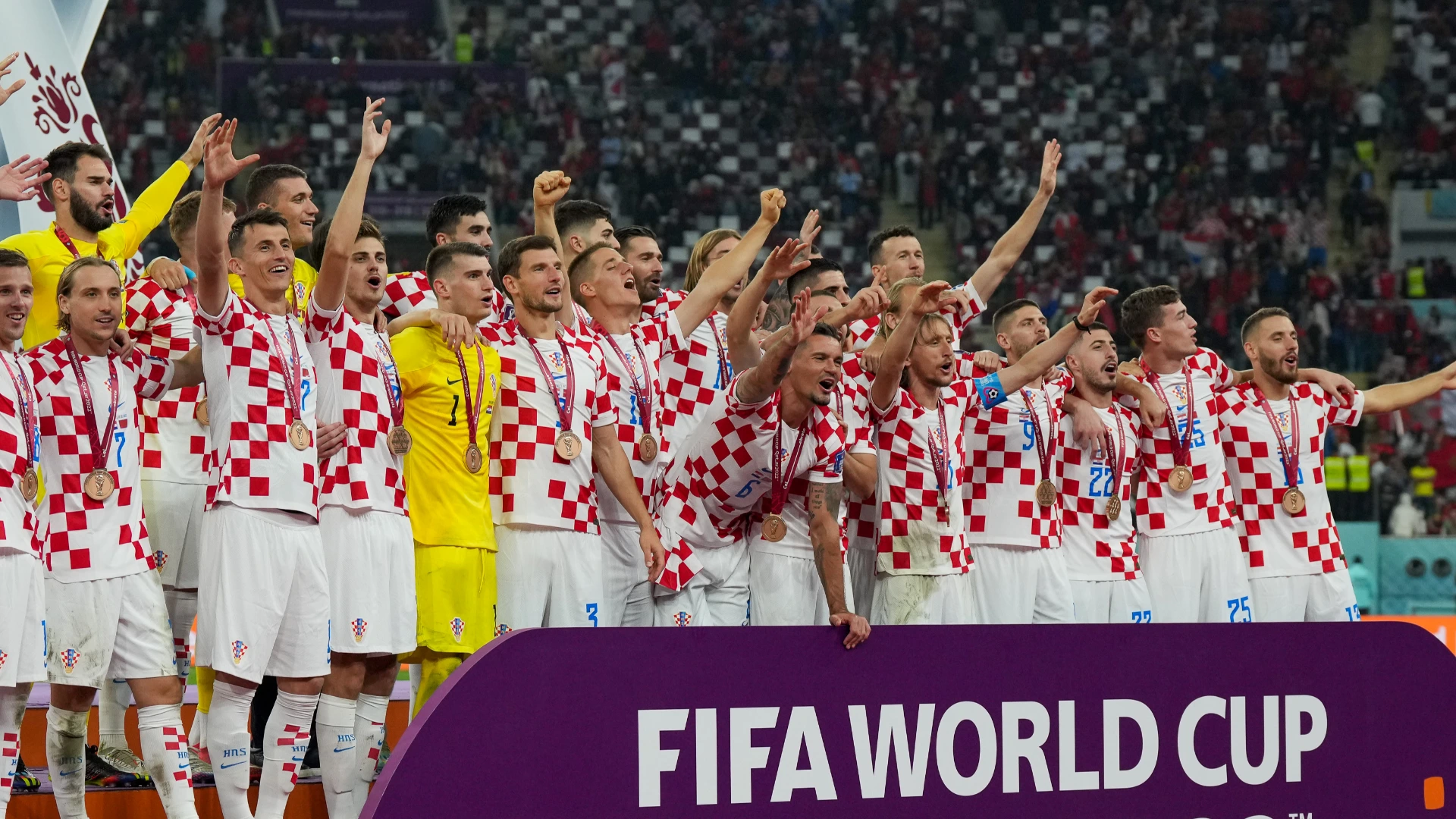
This brings us to 2022, the most recent third-place match played prior to Saturday’s game: in Qatar, Croatia faced Morocco, with the red-and-white-checkered team securing a 2-1 victory, driven by goals from Josko Gvardiol and Mislav Orsic. For the Atlas Lions—who were, however, the big surprise of the tournament—Achraf Dari scored the goal.