Football & Sports Marketing Festival: Voices from the Key Players
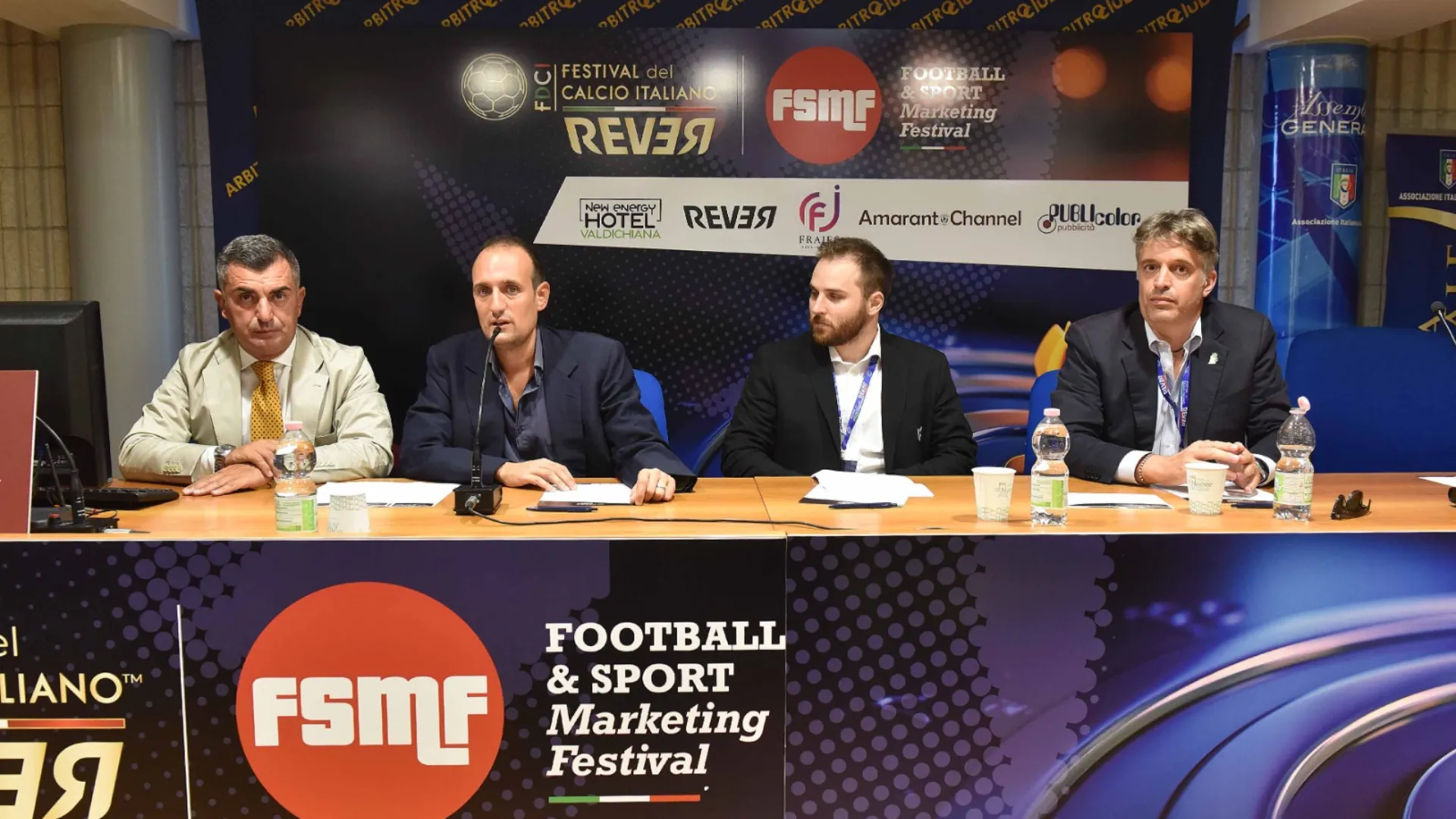
The Football & Sport Marketing Festival has once again proven to be a successful event that brings together worlds that may seem distant but are, in reality, united by the same goals. The Italian Soccer Festival has decided to highlight a profession that has now become deeply embedded in the world of sports. The first day of the Football & Sport Marketing Festival treated us to top-tier guests and a series of messages that will remain etched in the minds of the audience that gathered at the AIA Auditorium at Stadio Città di Arezzo.
The event officially opened with the customary remarks by Donato Alfani, President of the Italian Soccer and Sports Festival: “I thank President Sarri for his hospitality. Soccer isn’t just about the game itself; the tax aspect is also important. That is why I thank our speakers for explaining the dynamics of this field to us.”
Carla Vilucchi, president of the Order of Certified Public Accountants of Arezzo, then took the floor: “I bring greetings from my fellow accountants in the province of Arezzo. We stand by families and businesses. This year, we established a research foundation dedicated specifically to the development of our profession, which can serve as a resource for local sports clubs. As a mother of two children involved in sports, I can attest to the sacrifices required to make this happen, which is why I want to promote the sound principles of sports.”
This is followed by a statement from Fabrizio Mascarucci: “As certified public accountants in this region, we devote a great deal of time and effort to amateur sports clubs. Ninety-nine times out of 100, we have to address the challenges faced by these clubs, which have been exacerbated by the 2021 reform. The significant step forward, however, was establishing a fully-fledged association that meets the necessary requirements, so that issues such as those listed by the president could be promoted. Resources have decreased compared to the past, and marketing is now essential.” Finally, Simone Falomi also spoke: “Our organization works primarily with amateur clubs. Over the years, things have changed, and it has become necessary to follow specific models. The impact of marketing strategies runs parallel to social development, and we must adapt to market forces. The world of sports now needs our expertise.”
We are now moving into an area more closely tied to communication methods. Maurizio Di Ubaldo, in his capacity as director of marketing and communications for Sambenedettese, shares his experience. “Communication is part of marketing and generates profits. We need to promote certain products, and to do so, we rely on professionals such as social media managers. As for Sambenedettese, several initiatives have been introduced in this direction to accelerate this process.”
Among the most interesting insights from the talk on “Media and Market Segmentation,” it’s worth mentioning the testimony of Emanuele Giorgi, head of the press office at Pianese, a Tuscan club in Lega Pro. “In Piancastagnaio, the players become part of the village community. Playing in Serie C means attracting the interest of other clubs nationwide. We, too, in terms of communications, have had to adapt to the new division without, however, losing our identity. We must be aware that there isn’t just one type of fan, and we work to spread the black-and-white culture even beyond Piancastagnaio.”
Next are the words of Claudio Baccolini, head of marketing and communications at Federkombat: “Ours is a very young organization: a new frontier. Communicating effectively within a federation like ours isn’t easy: we entered the European scene in the late 1980s and have only been a CONI-recognized federation for a few years. Figuring out how and what to communicate is among the most challenging tasks in our sector. Our federation strives to create a narrative within the gyms. Our goal is to find a single message that appeals to everyone. Identifying the right target audience must be done on a case-by-case basis, depending on the situation at hand.”
The final talk of the day, on the other hand, focuses on the concepts of the athlete, sponsor, and brand as a single product, and attempts to delve deeper into the subject. Simone Fantozzi, commercial marketing manager at Pianese, explains his role as follows: “It’s a unique opportunity where I put what I’ve learned to work for the local community. The work isn’t easy: we’re a small, relatively new organization; we sell our product to a primarily local audience, but our strength comes first and foremost from the club itself, which believes so strongly in the project. We’ve set up a hospitality program, we’ve sought to strengthen our brand with the launch of ‘Pianesina,’ and we’ve established a hostess service. The Pianese model is based on a strong relationship with the local community, which goes beyond sponsorship.”
Gianluca De Rosa, Mantova’s head of media communications and marketing, broadens the conversation: “Sporting results always shift perceptions of us to some extent. The victory over Lazio in the Coppa Italia, for example, increased our club’s visibility. We’re also working to bridge the gap with other, more prestigious clubs in Serie B: Palermo, from this perspective, is a prime example. Strategies vary depending on the division and the competitors. The fan base varies, so we must adapt to the system’s rules.”
Also important are two voices who are not employees of soccer clubs and, therefore, contribute their expertise as independent professionals. Alessandro Bargnani, Director of Italian Sports Psychologists and a FIGC instructor, focuses on mental health: “It matters a great deal. Taking care of oneself allows you to prevent issues and monitor your own well-being. When competitive play ends, we see how lifestyle changes, and the psychological state is generally the first to be affected. That’s why we always have to stay on top of things. That’s why our role is in such high demand today, and we’re happy about it.” Daniele Ghilardi, a sports psychologist and UEFA B coach, adds: “The role of the mental coach has finally been legitimized. I believe that a professional like us should be part of every organization’s structure. Behind every athlete or worker, there is always a human being, with their own strengths and vulnerabilities. We’re not machines that are constantly overloaded.”
For the second consecutive year, Arezzo has been chosen as the Italian Capital of Soccer and Sports, reaffirming its commitment to hosting events of national significance designed to promote the values of sports and highlight the region’s assets.
Special thanks go to the Manzo family and, in particular, to President Guglielmo Manzo, whose constant support has contributed significantly to the Festival’s growth and to the realization of high-profile initiatives throughout Tuscany.