2026 World Cup: Was Jude Bellingham’s Goal Illegal? The “Spidercam” Controversy Erupts in Norway vs. England
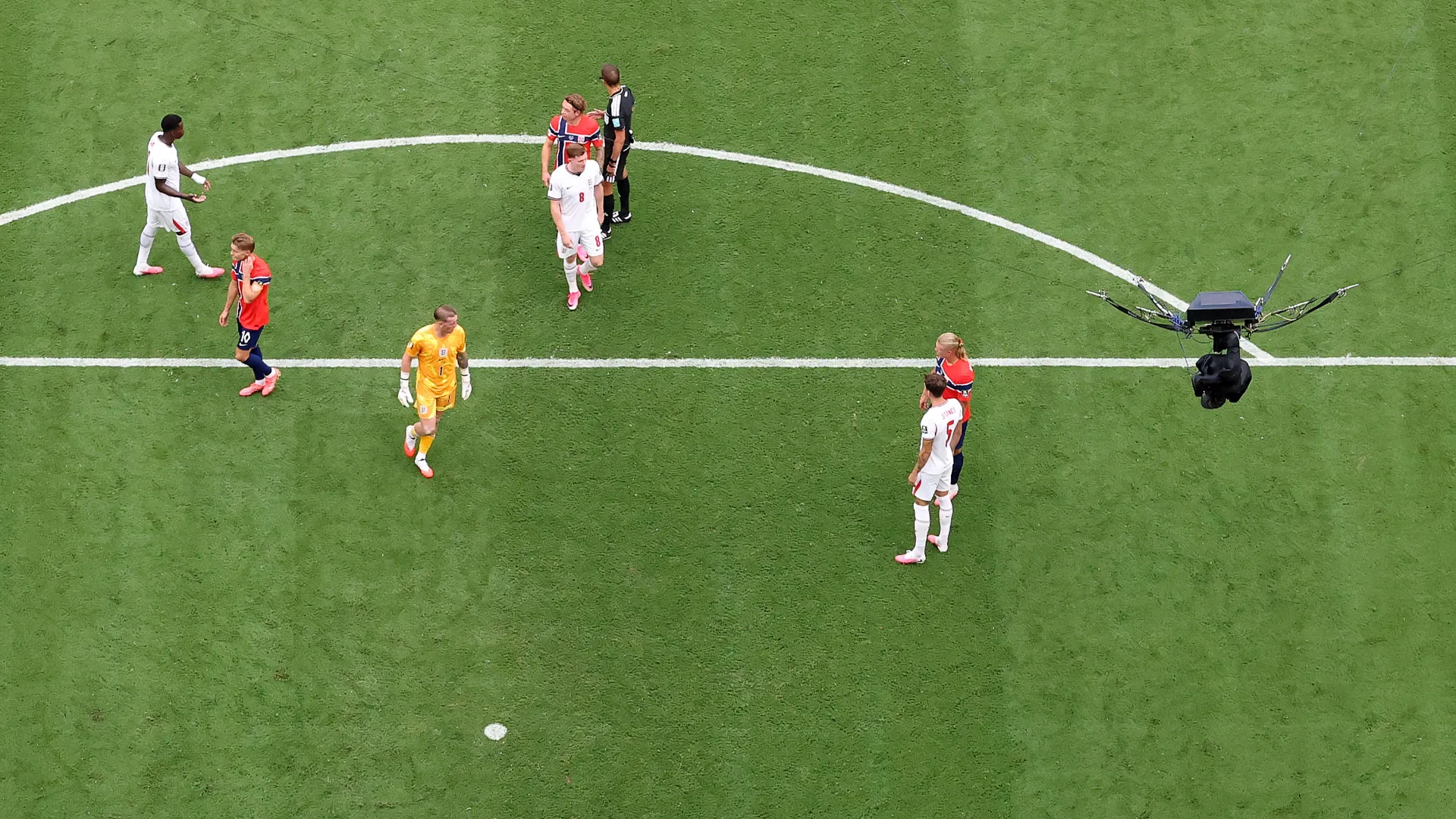
England defeated Norway 2-1 in extra time in a heated quarterfinal match at the 2026 World Cup, but after the game ended, a controversy erupted that is bound to be the subject of lengthy debate. The goal that temporarily tied the game, scored by Jude Bellingham in stoppage time of the first half, appears to have been marred by a serious flaw: a decisive deflection by a cable from the Spidercam, the gyroscopic mobile camera suspended above Miami’s Hard Rock Stadium.
Footage of the play in question, which began circulating after the 120th minute, quickly went viral and sparked outrage in Norway. The play begins with a very high throw-in from the back by Scandinavian goalkeeper Nyland: in the overhead footage, the ball can be seen rising like a bell tower and then plummeting toward the field at a perpendicular angle, losing the trajectory that would have been natural. According to the Norwegian team, there could have been only one consequence: the play should have been stopped. This, in turn, would have prevented Bellingham’s decisive goal.
This highly contentious issue was promptly addressed by FIFA in a statement asserting that “the ball’s trajectory showed no deviation.” In other words, if the ball had come into contact with the cable of the camera suspended above the stadium (the infamous Spidercam), a chip inside the ball should have beeped. But this did not happen, so much so that even VAR detected no irregularities. The incident did occur, however, at the height of a match like Norway vs. England, which was marked by several decisions by referee Turpin that were contested by both teams.
After all, this wasn’t the only refereeing decision that came under scrutiny during the match. In the 36th minute, Turpin had already sparked controversy by letting play continue after contact between Berg and Kane: as the play unfolded, Schjelderup had put Norway ahead with a great left-footed shot off an assist from Odegaard, beating Pickford—who that very evening had set the record for most World Cup appearances by an English goalkeeper, surpassing the legendary Peter Shilton. In the second half, VAR denied Norway what appeared to be a go-ahead goal, ruling that Haaland had pushed an opponent on a corner kick, while in the second half of extra time, Turpin initially awarded a penalty for a foul on Spence, only to reverse his decision following an on-field review.
The context in which the match at Hard Rock Stadium took place made everything even more complicated. The match was played under extreme weather conditions, with a heat index nearing 44°C due to the extremely high humidity typical of South Florida at this time of year. The City of Miami had issued an official advisory earlier that day urging residents to stay as hydrated as possible and limit outdoor activities, while FIFPRO had called for matches to be rescheduled if temperatures exceeded 28°C. This is not an isolated incident in this tournament: in Philadelphia, during the Round of 16 match between France and Paraguay, the thermometer had already hit 38°C, with heat index readings nearing 46°.
Further complicating matters for Norway on the eve of the match was a stomach virus that had struck several members of the squad following their historic victory over Brazil—the win that had eliminated the heavy-favorite Seleção thanks to a two-goal performance by Haaland. Head coach Solbakken himself was not feeling his best and could not hide the issue during the press conference. On the English side, however, Tuchel had to do without Jarell Quansah—suspended for two matches by FIFA following his red card against Mexico—and Jordan Henderson, who was injured during the post-match celebrations at Azteca Stadium.